
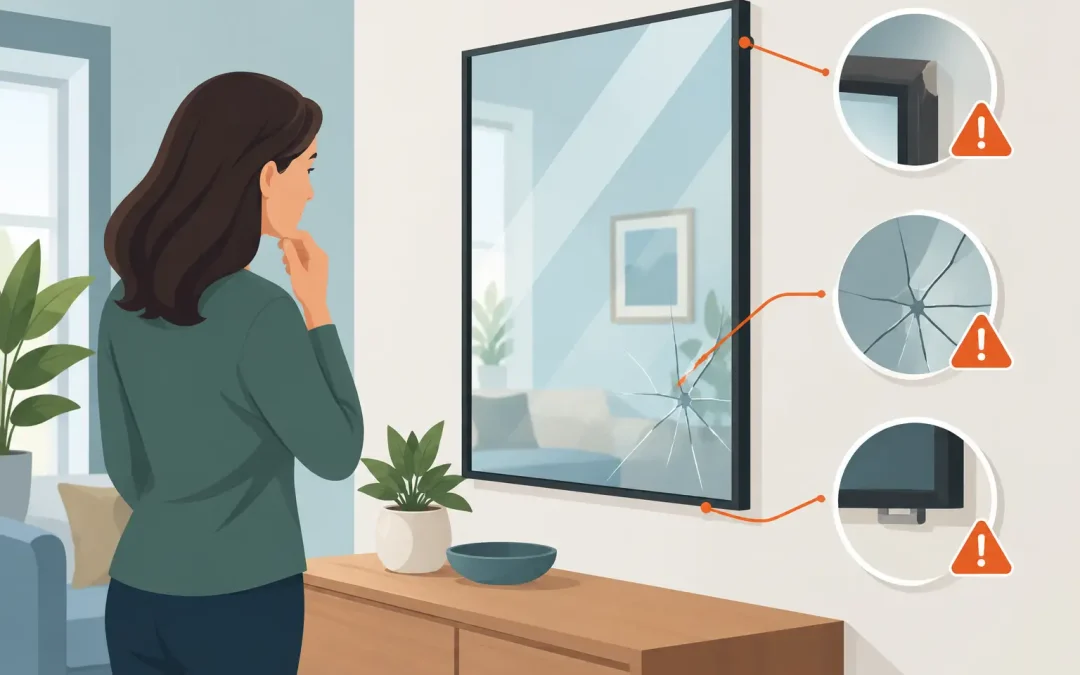
A mirror can look fine from across the room while becoming a real hazard up close. A small crack near the edge, a loose wall fixing or black marks creeping in behind the glass can turn an everyday bathroom, wardrobe or hallway mirror into something that needs attention. Knowing how to identify unsafe mirror damage helps you act before glass falls, breaks further or leaves sharp pieces where children, pets, customers or staff can reach them.
How to identify unsafe mirror damage
Start by looking at the mirror from the front and the sides in good light. You are not trying to diagnose every mark perfectly. You are checking whether the glass is damaged, unstable or likely to cause injury if it shifts.
A crack is the clearest warning sign. Even a fine line can weaken a mirror, particularly when it runs from an edge or corner. Cracks often spread after a door slams, a wall flexes slightly or someone bumps the glass while moving furniture. A star-shaped impact mark, chipped corner or missing piece is also a sign the mirror should not be left as it is.
Pay close attention to the edges. Mirror edges are vulnerable because they are often hidden by a frame, clips or adhesive. If you can see a sharp chip, a jagged section, flaking glass or a corner lifting away from the wall, keep people clear of it. Do not run your fingers along the edge to check it. A visual inspection is enough.
Then check whether the mirror is secure. A wall mirror should sit firmly against its surface without rocking, rattling or moving when a nearby door closes. You may notice a gap opening along one side, a fixing clip that has bent or come loose, or old adhesive that is no longer holding evenly. Large mirrors are heavy. If one comes away from the wall, it can cause serious injury even if the glass itself is not cracked.
Black spots, cloudy patches and brownish staining are another issue worth checking. This is usually damage to the reflective backing rather than a crack in the glass. It does not always mean the mirror will shatter, but it can point to long-term moisture exposure, especially around bathroom mirrors. If backing damage appears alongside lifting edges, loose fittings or cracking, arrange an assessment rather than waiting for it to worsen.
Signs a mirror needs urgent attention
Some mirror problems can wait for a planned replacement. Others need you to make the area safe straight away. Treat the situation as urgent if glass has fallen, the mirror is hanging loose, a crack is spreading, or sharp pieces are exposed.
A mirror is also unsafe when it has broken into multiple pieces but is still held together by a frame, adhesive or backing film. It may look contained, yet pieces can release without much warning. Avoid pressing broken sections back into place or trying to straighten them.
Be especially cautious with mirrors on sliding wardrobe doors, full-height hallway walls, bathroom walls and commercial premises. These mirrors are often large, mounted overhead or positioned where people pass close by. A small issue in these locations can become a bigger risk quickly.
If a mirror has been hit hard, such as during furniture moving, a break-in, a plumbing repair or an accident at work, inspect it even if there is no obvious smash. Damage can begin at the edge or behind a frame where it is easy to miss.
Check the mounting, not just the glass
An unbroken mirror can still be unsafe if the installation is failing. Older mirrors may be held in place with ageing adhesive, corroded screws or clips that no longer suit the weight of the glass. Bathrooms are a common trouble spot because steam and moisture can affect surrounding materials and fixings over time.
Look for movement at the top corners and along the lower edge. A mirror that appears to bow away from the wall, sit unevenly or make a faint clicking sound when the wall or vanity is bumped should be checked by a qualified glazier. Never test a loose mirror by pulling it towards you. That can cause it to release suddenly.
Framed mirrors need attention too. Timber frames can swell, split or rot in damp rooms, while metal frames may corrode. If the frame no longer holds the glass firmly, replacement may be safer than repairing only the frame. The right option depends on the mirror’s size, location, condition and how it was originally fitted.
Bathrooms, bedrooms and busy areas need extra care
Not every mirror carries the same level of risk. A small, securely mounted mirror above a low-use basin is different from a floor-to-ceiling wardrobe mirror in a family bedroom. Consider who uses the space and how likely the mirror is to be knocked.
In bathrooms, look for damage around the bottom edge and near taps, showers and vanity tops. Repeated moisture can affect the backing and mounting over time. If the mirror is close to a shower, bath or a spot where someone could slip into it, a glazier can advise whether replacement glass and suitable safety measures are needed for that location.
In children’s rooms and play areas, avoid leaving a cracked or freestanding mirror in place, even for a short time. Young children may touch sharp areas or pull on a mirror that is not properly secured. The same goes for homes with energetic dogs, particularly near entryways and wardrobes.
For shops, offices and rental properties, a damaged mirror can create a safety issue as well as a maintenance problem. Property managers and business owners should isolate the area, document the damage where needed and organise a prompt repair. Waiting until the next routine maintenance visit is rarely the right call when glass is involved.
What to do when you find an unsafe mirror
First, keep people away from the area. If the mirror is cracked or shedding glass, close the door or use a clear barrier so nobody brushes against it. Keep children and pets out until it has been made safe.
Do not attempt to remove a large wall mirror yourself. The glass can break under its own weight once a clip, frame or adhesive bond is disturbed. Covering a cracked mirror with cardboard or a towel may reduce contact with sharp edges temporarily, but do not tape, drill, screw into or heavily press on damaged glass.
For loose fragments on the floor, wear enclosed shoes and keep your hands protected. Pick up larger pieces carefully only if it is safe to do so, then use a brush and pan for smaller shards. Avoid using a household vacuum on glass, as fragments can damage it and may remain in the machine. Check the surrounding floor, skirting boards and nearby soft furnishings before reopening the space.
If the mirror is still mounted but unstable, leave it in place and arrange professional help. A qualified glazier can assess the glass, measure accurately, remove it safely and fit a replacement suited to the setting. This is often quicker and far less risky than trying to save a damaged mirror yourself.
When replacement is the better choice
Minor backing marks do not always require immediate replacement. However, a cracked mirror, a mirror with damaged edges or one that has come loose should generally be replaced rather than patched. Glass repair has limits, and a cosmetic fix does not restore strength to broken mirror glass.
Replacement is also a chance to solve the cause of the problem. A new mirror may need more suitable fixings, better edge protection, a different mounting method or glass selected for a wet area. If the old mirror was fitted before a renovation, it may no longer suit the room or the way the space is used.
For custom-sized mirrors, the measurements and installation method matter just as much as the glass itself. An experienced glazier can check the wall surface, surrounding tiles or cabinetry, access to the area and the mirror’s intended use before recommending the right approach. Glass Direct handles mirror replacements and custom-fit glass across Auckland, with the removal, fitting and clean-up managed as part of the job.
A mirror should make a room more useful, not make you hesitate every time someone walks past it. If you can see damage, movement or exposed edges, treat that as your cue to clear the area and get a professional assessment before a small problem becomes broken glass on the floor.