
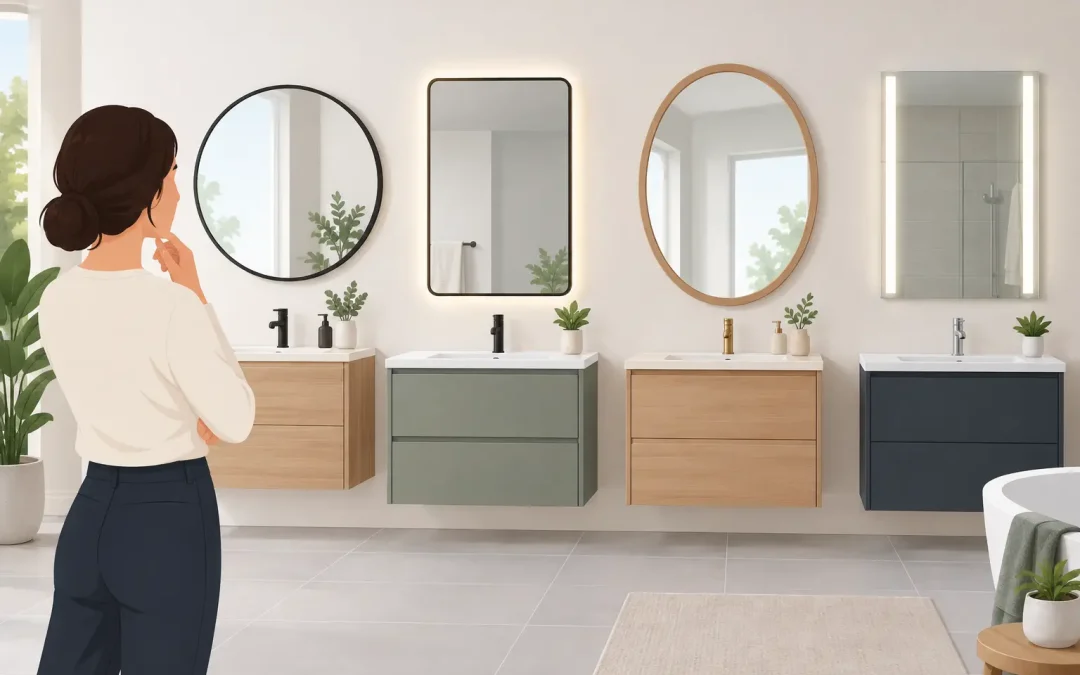
A bathroom mirror does more than show you whether you have toothpaste on your chin. The right bathroom mirrors make a compact room feel brighter, help with the morning rush, and finish the space without taking up valuable floor area. The wrong one can leave the room feeling dark, awkwardly proportioned, or simply hard to use.
For most homes, choosing a mirror comes down to a few practical details: the size of the vanity, where the lights sit, who uses the bathroom, and whether the wall can safely carry the glass. Start there and the style decision becomes much easier.
Start with the vanity, not the empty wall
The vanity is usually the best guide for mirror size. A mirror that is roughly the same width as the vanity, or slightly narrower, tends to look balanced and gives everyone enough viewing space. A much wider mirror can work, particularly over a double vanity, but it needs to feel intentional rather than like a spare sheet of glass has been fitted to the wall.
Height matters just as much. In a family bathroom, the mirror should suit the adults who use it most while still being practical for older children. As a general rule, place it high enough that it clears taps and splashbacks, but low enough that its centre sits around average eye level. The exact position depends on the vanity height, basin design and the people in the household.
A full-width mirror above a vanity is a sensible option when the room is narrow or light is limited. It reflects more of the room and can make a small bathroom feel less boxed in. The trade-off is that it shows water spots and fingerprints more readily, especially around a busy basin. A smaller framed mirror is easier to define as a feature and can add warmth, but it will not give the same sense of space.
Choose bathroom mirrors for the way you use the room
There is no single best shape. Rectangular mirrors remain popular because they work with most vanities, tiles and cabinetry. They are straightforward to measure, easy to position, and available in portrait or landscape layouts.
Round and oval mirrors soften a bathroom with lots of straight lines. They work particularly well above a single basin, especially where the vanity has a simple, clean front. They can make a room feel more relaxed, although they provide less usable reflection at the outer edges than a rectangular mirror of the same overall width.
Arched mirrors sit somewhere between the two. They add character without being too decorative, but their shape needs enough clear wall space above the vanity to look right. In a low-ceilinged bathroom, a tall arch may feel cramped.
Frameless mirrors are a practical favourite because they suit almost any renovation style and are easy to wipe down. A polished edge gives a clean finish, while a bevelled edge adds a little detail without needing a frame. Framed mirrors can introduce colour, timber texture or a darker contrast, but make sure the frame is designed for wet areas. Bathrooms create moisture, and a frame that is not properly suited to the environment can swell, peel or deteriorate over time.
Get lighting and placement working together
A mirror cannot fix poor lighting, but it can make good lighting work harder. The most flattering arrangement has light reaching the face from both sides or from the front. A single downlight directly above the mirror often creates shadows under the eyes and chin, which is not ideal for shaving, make-up, skincare or getting ready for work.
Wall lights placed either side of the mirror are effective where the layout allows it. An illuminated mirror can also be a good solution in a smaller bathroom or ensuite where there is little room for separate fittings. Before choosing one, consider where electrical connections will sit and how future repairs would be handled. It is worth planning this before tiling or finalising cabinetry.
Avoid putting a mirror directly opposite a messy storage area, laundry pile or toilet if you can help it. A mirror doubles what it reflects. Facing it towards a window, a lighter wall or an attractive tiled surface will make better use of the reflected light and view.
In rooms with a window behind the person using the mirror, lighting becomes even more important. Strong backlighting can turn a simple task into a squinting exercise. Side lighting or a well-positioned illuminated mirror will usually solve the problem.
Safety comes before style
Bathroom glass needs to be treated with care. Mirrors may look solid on the wall, but they are heavy, and a poor installation can become a real hazard. This matters even more in homes with children, rental properties, shared bathrooms or spaces where doors are frequently slammed.
The wall type affects the fitting method. Plasterboard, masonry, tiled walls and walls with studs behind them all need to be assessed properly. A large mirror may require mechanical fixings, adhesive, or a combination of both. The fixing points must support the glass for the long term, not merely hold it in place on installation day.
If a mirror is installed above a basin, check that it is not likely to be knocked by tall tapware, cabinet doors or an upward-opening shaving cabinet. Also consider the edge clearance around power points, light switches and towel rails. Small details at the measuring stage prevent frustrating changes later.
For custom-cut mirrors, a qualified glazier can advise on the right thickness, edge finish and mounting method for the size and location. That is particularly useful for oversized mirrors, mirrors fitted over tiles, and pieces with cut-outs for lights, cabinetry or fixtures.
When a bathroom mirror should be replaced
A cracked or chipped mirror is not something to ignore. Even a small chip at the edge can worsen with time, cleaning, moisture and everyday movement in the home. Cracks can spread, and damaged edges can be sharp.
Black marks around the edge are another common issue. This is often called desilvering, where moisture has affected the backing behind the glass. It may begin as a small dark line, then gradually spread. It does not always mean the mirror will break, but it will not improve on its own and can make an otherwise tidy bathroom look tired.
Replace a mirror if it has loose corners, visible movement, failed adhesive, deep scratches or damaged backing. Do not try to cover a crack with tape and carry on as normal. In a wet room, temporary fixes have a habit of becoming a bigger job later.
If the glass has broken, keep children and pets away from the area, wear enclosed shoes, and avoid pressing on loose pieces. A professional can remove the damaged mirror, take accurate measurements and fit a replacement that suits the existing bathroom. Glass Direct handles mirror repairs and custom replacements across Auckland, including practical replacements where matching the existing size matters.
Measuring for a replacement mirror
Accurate measuring is the difference between a mirror that looks built for the space and one that almost fits. Measure the available width and height in several places, especially if walls are tiled or not perfectly square. Record the smallest measurement, not the largest.
Decide early whether you want the new mirror to sit above the splashback, overlap it slightly, or run down to the vanity. Each approach can look good, but the mirror should not interfere with taps, cabinets or lighting. For a replacement in an existing position, note the location of old screw holes and any areas where adhesive remains.
If you are unsure, it is better to arrange a measure than order glass based on a rough estimate. This is especially true for large mirrors, shaped mirrors, or glass that needs holes and cut-outs. Glass cannot be trimmed after it has been toughened, and even standard mirror glass needs accurate sizing before it is cut.
Keep the finish looking good
Most bathroom mirrors only need a soft microfibre cloth and a glass cleaner used sparingly. Spray the cloth rather than soaking the mirror, particularly near the edges. Excess moisture can work behind the glass and affect the backing over time.
Avoid abrasive pads, harsh powders and scraping blades. They can damage the surface or leave fine scratches that catch the light. Wipe splashes away regularly, keep ventilation running after showers, and deal with leaking taps or poor seals near the vanity. These small habits help a mirror last longer and keep the room looking cared for.
A well-fitted mirror should quietly do its job every day: give you clear light, useful reflection and a bathroom that feels more open. If yours is cracked, clouding at the edges or simply the wrong fit for the room, replacing it is one of the simplest ways to make the space safer and more enjoyable to use.